Sunday, September 5, 2010

Peppersauce Ghost Town

Bridge Crossing into East Calico aka Peppersauce Ghost Town

The highway north into central Missouri from Arkansas is full of twists and turns through mostly forested wilderness, and a mostly undiscovered history. It is here that quiet little ghost town attached to a living community sits quietly crumbling on the bluffs of the White River.


East Calico started like many towns of 1800s, as a trading post for French traders and trappers traveling the White River. Numerous little taverns appeared, and the site became home to various thieves, vagabonds, and other troublemakers indulging in “Peppersauce,” the local moonshine; along with that, prostitution, fist-brawls, knife fights and gun battles.


By the 1890s, homes had begun to appear along the bluffs, and a bit of a community started to form. The taverns continued serving though, making the town still a bit unfit for regular folks. News of the intent of the railroad to lay tracks along the bluff in 1902, and the promise of the associated prosperity, encouraged the law-abiding citizens to run the taverns and their patrons out.

In 1903, the train started making regular stops in Calico Rock, and homes and businesses sprang up, providing work for anyone looking. The town hosted a thriving community until the 1940s. A local electric plant closed when high tension lines came through, food and cotton harvests were replaced with cattle farms, and over-foresting silenced the timber mills; folks were forced to find work elsewhere. By the time the 1960s rolled around, the train no longer made stops there, everyone had moved on to other more sustainable destinations.
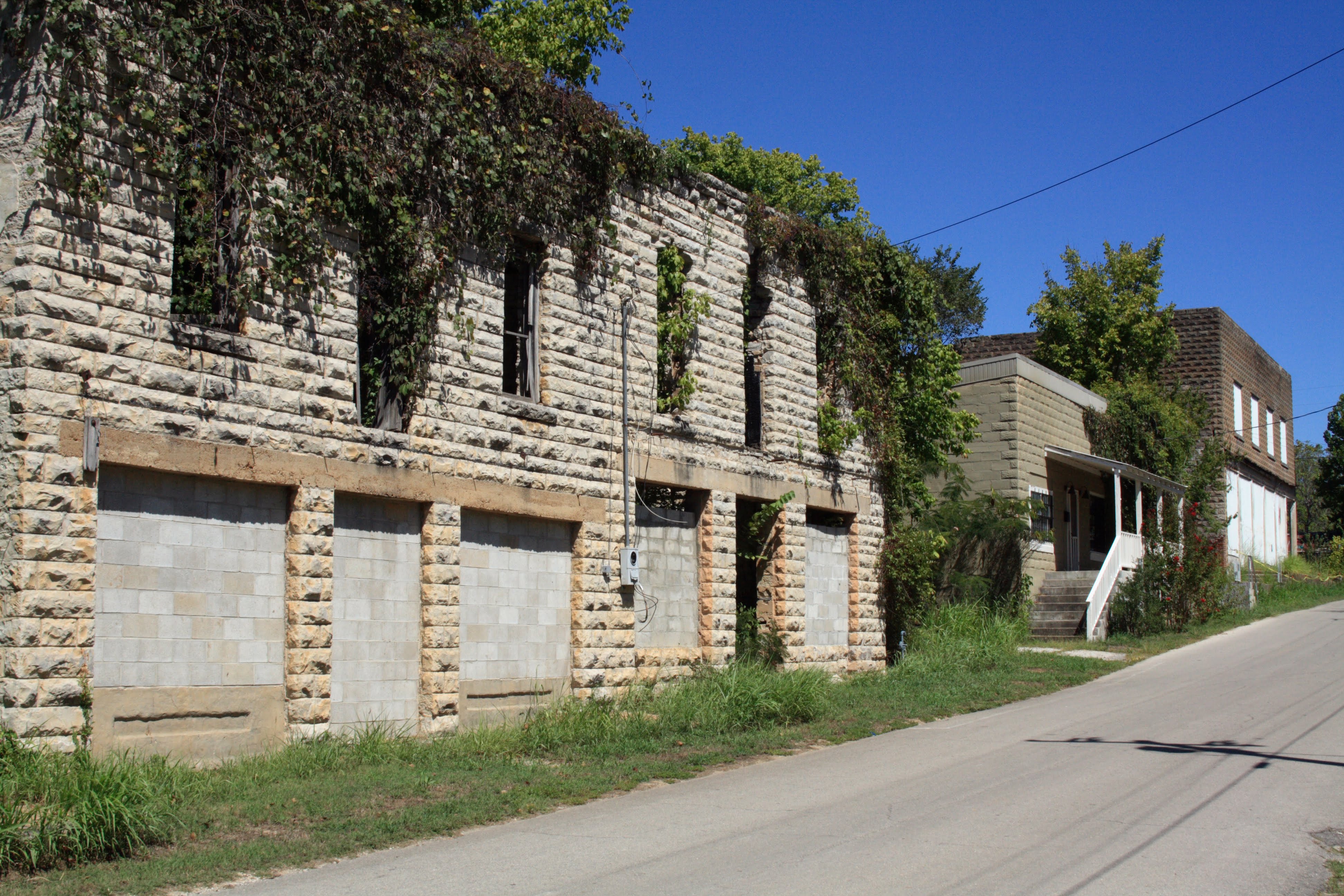
A few folks remained on the outskirts of town, and many locals still favored the spot for trout fishing, so the area was never completely abandoned. A new prison brought back a few residents in the late 1960s, but the once bustling town that had grown up east of Calico Creek remained empty, and a ghost town. The property was bought up over time, but many of the buildings collapsed, burned, or were overtaken by undergrowth; only about 20 buildings remain today.

... Further Reading …

East Calico Rock Historic District Ghost Town
Arkansas.com

Thursday, July 8, 2010

Skyline Drive Archaeology


Constructed by local prison labor in 1903, Skyline Drive begins its gradual ascent halfway up the ridge, just a short 3 miles out of town by way of Highway US-50; only really a couple of thousand feet from town, by foot.

The narrow roller coaster ride along Skyline Drive

There are a couple of pullouts along the gradual ascent to the top. Visitors can take in views of YMCA Mountain and Fremont Peak to the west, and the Twin Mountains to the north, or inspect excellent rock exposures of the ridge itself, known to be fossiliferous.

Reaching the top, another pullout provides a full 360-degree view of the surrounding landscape; the previously mentioned mountains to the north and the west, and all of Cañon City to the east.

Cañon City from Skyline Drive

This panoramic view continues virtually uninterrupted for the remainder of the seemingly perilous one-mile roller coaster ride across the top of the ridge. There is not much room for error along this portion of the route, and no further pullouts until near the end of the ridge.

Near the end of the ridge, Skyline Drive switches back to the north and begins its gradual descent to the smaller “Hogbacks” separating the ridge from the town, switches back once more, then empties into a residential area.

Smaller Hogbacks below Skyline Drive

There have been numerous new dinosaur fossil finds along the ridge and Skyline Drive over the years, one as recent as 1999. While out for a Sunday drive in 1999, a paleontology student from the University of Colorado discovered dinosaur tracks along the ridgeline. They had apparently been visible for years, but to the untrained eye, just another bunch of rocks.

Closeup of the limestone along Skyline Drive

Excavating the ancient track lines during early 2000, a local crew took molds for display at the local Dinosaur Depot Museum, along with other fossils discovered at that time, including tree roots and branches. Most of the discoveries throughout the years are also on display there. Various signage along the route indicates the location of these finds and explain their history and relevance to the region in detail.

Saturday, December 12, 2009

Olean and the FDA


Olean, the brand name for Olestra, a fat-substitute produced by Proctor & Gamble, which is apparently fat, calorie, and cholesterol free.  The substance works to prevent the body from accumulating fat from the food it is on or cooked with in two ways.  Primarily, the molecule is too large to be digested by the human body, through normal processes an it accelerates the digestive system.

It was hailed as the salvation to obesity when first released; unfortunately, not without serious side effects.  Numerous cases of stomach pain, uncontrollable diarrhea, and a loss of essential nutrients, soon made Olean a product to be avoided.

It seems that the FDA failed again and probably profited in some way through its interaction with Proctor & Gamble.  Not only was Proctor & Gamble able to produce and release a product without sufficient testing, but the FDA allowed the product to persist in the marketplace, in spite of continuously mounting evidence of health concerns.  Additionally, when sales of products containing the ingredient nose-dived, the FDA threw its full support behind Proctor & Gamble, deciding that it was no longer necessary to warn the public of the negative side effects.  

This situation is yet another piece of evidence that corporate America and the FDA work side-by-side, and not always in the interest of the consumer.


Sunday, December 6, 2009

A few thoughts on Hydrogen


Hydrogen fuel is probably one of the best relatively untapped natural resources available to modern man and remains largely ignored in favor of fossil fuels.  Additionally, certain disadvantages apparent when compared to fossil fuels have slowed the implementation of this mostly safe and clean burning fuel.

Hydrogen fuel use in the internal combustion engine produces less horsepower, as well as a decreased driving range.  For many car owners, this is not an acceptable trade-off.  The gas also has less energy density, requiring larger storage containers and facilities. (1)

As a highly volatile gas, larger storage facilities increase the risk of disaster, and present numerous logistical problems with transport to distribution centers.  Though it is the most common element in the universe, it is difficult to generate, store, handle, and distribute. (2)

Benefits of the use hydrogen outweigh all of the disadvantages though.  The waste product is nothing more dangerous than water; as well, no carbon, means no carbon dioxide.  Overall mechanical inefficiencies are reduced or eliminated, because there is no transfer of power, as with a combustion engine.  Run-time is limited by the amount of fuel available, creating scalability to nearly any application. (3) Probably the biggest benefit is energy security for the future, since it is the most common element in the universe.

Hydrogen could enable independence from massive utility infrastructures, and a greater self-reliance.  The cost and environmental savings, from more the more localized attributes of hydrogen fuel generation and distribution, pays for itself in reduced maintenance and new construction costs of traditional fossil fuel facilities. (3) Hydrogen is indeed, the best alternative.

  1. Hydrogen Fuel Source.  Alternative Fuels.  [article online] 2004.  Available from http://www.altfuels.org/backgrnd/altftype/hydrogen.html .  Accessed 2009 Dec 6.
  2. Snyder, Andrew.  Hydrogen Internal Combusion. Columbia University.  [article online]  2003.  Available from http://www.columbia.edu/~ajs120/hydrogen/web-pages/h-fuel-cell-how.html .  Accessed 2009 Dec 6.
  3. Advantages & Benefits of Hydrogen Fuel Cell Technologies.  Fuel Cell Markets.  [article online] 2009.  Available from http://www.fuelcellmarkets.com/fuel_cell_markets/5,1,1,663.html .  Accessed 2009 Dec 6.

Saturday, November 28, 2009

On site Disposal of Nuclear Waste


Nuclear waste, whether from a reactor or a discarded missile, is as sensitive a political topic as the means by which the waste was generated.  Whether the disposal concerns low-level or high-level waste, the consensus is that nobody wants the waste disposed of anywhere near them.  Therein lies the problem of what do with the waste.  Should it be stored on-site, or should all nuclear waste be disposed of in one central location.

A large, centralized stockpile of nuclear waste has the potential to be a hazard greater than permanent local storage.  Should an incident occur at the storage, the effects could be farther reaching than calculable.  Even today, scientists are not completely aware of the full extent and long-term repercussions of seepage of waste into any particular ecosystem.

Low-level radioactive materials should definitely be stored locally, at the site of production.  Dissipation of radioactivity can be measured in terms 10-50 years with this type of radioactive material, and containment of the waste is achievable by current methods. 

High-level radiation is a different issue.  Out of sight, out of mind, creates more problems than can be solved.  On-site storage would undoubtedly cause those responsible for the waste to be more conscious of the continuing growth in scope of their problem.  Indeed perhaps, it would be the impetus for advancement in disposal methods.


Popular Variations